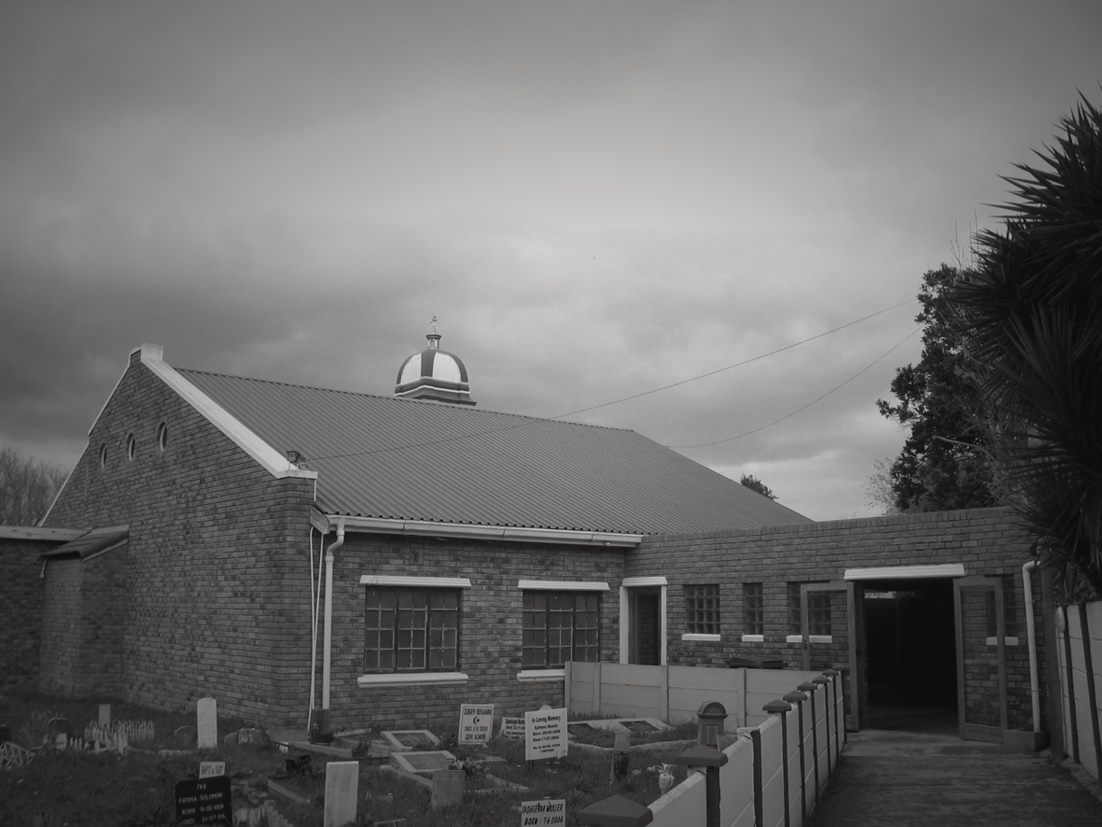
When almost everything else was taken, this ground remained. The Spaanschemat River Road Muslim Cemetery is where a community removed by apartheid still returns, in death, to the valley of its ancestors.
1883 — an anchor for the valley
Opened with the mosque it stands beside
The Spaanschemat River Road Muslim Cemetery opened in 1883, at the same time as the Masjid Monier alongside it. Part of the property was donated by a woman remembered only as Naeemah, on which the mosque and a portion of the cemetery were established.
In 1924, the southern portion of the cemetery was bought by 105 families — among them the Solomons — for £3 5s. A section of this lower ground was later sold to the Wynberg community and became known as the Strawberry Lane Muslim Cemetery.
The cemetery on Spaanschemat River Road, Masjid Monier rising behind — sacred ground the community still returns to.
1883
Cemetery & Masjid Monier opened
105
Families bought the southern ground in 1924
4,000+
Buried here over its history
~99%
Of members removed under the Group Areas Act
A final return
The ground a community could still claim
When the Group Areas Act emptied Muslim Constantia, the mosque and the cemetery were almost the only ground the community could still call its own. Families scattered across the Cape Flats kept the institutions alive — and those who held burial rights were able to make a final return to Constantia in death.
Today, burials reach the sixth and seventh generations of descendants. Many who now live far from the valley still wish to be laid to rest here.
"Around 99% of its members were expelled from Constantia during the Group Areas Act, and the cemetery and the mosque could be the only places that could be claimed by the Muslim community."Natheem Hendricks, committee chairperson · Constantiaberg Bulletin, 2025
Today — keeping the record
Tending the graves, preserving the names
The cemetery is cared for by the Spaanschemat River Road Muslim Cemetery Association, alongside Masjid Monier's committee. To maintain the grounds, the association collects a modest annual family membership; a once-off fee is paid to the groundsman who digs each grave.
In recent years the association has begun geo-tagging the graves so that families can find their loved ones — more than 1,000 graves have been mapped, while older, unmarked graves remain unnamed. Custodians like Abduragman Allie, who has served for more than forty years, made a promise to an older generation to look after this ground — and keep its history from being lost.
"This is part of their heritage; they were removed, though they still want their burial space in Constantia."Natheem Hendricks · Constantiaberg Bulletin, 2025